CI/CD³: Why Continuous Diagramming Is the Missing Third Pillar of Modern Software Delivery
We automated the build. We automated the deploy. It's time to automate the understanding. Introducing CI/CD³ — Continuous Integration, Continuous Delivery, Continuous Deployment, and Continuous Diagramming.
🎙️ Listen to this article
Podcast generated with NotebookLM
In 2001, the Agile Manifesto declared that working software matters more than comprehensive documentation. It was the right call. We stopped writing 200-page specs nobody read and started shipping. But somewhere along the way, we threw out something we still desperately need: shared understanding. CI/CD transformed how we build and ship software. Continuous Integration meant broken code got caught in minutes, not weeks. Continuous Delivery meant features reached users in hours, not months. Continuous Deployment meant every passing build went straight to production without a human gate. These weren't just engineering improvements — they were organizational upgrades. They changed how teams communicate, how trust is built, and how fast a business can move. Yet in 2026, the average enterprise architecture diagram still lives in a shared drive. Last updated: Q3 2023. Author: someone who left the company. We automated the pipeline. We forgot to automate the map.
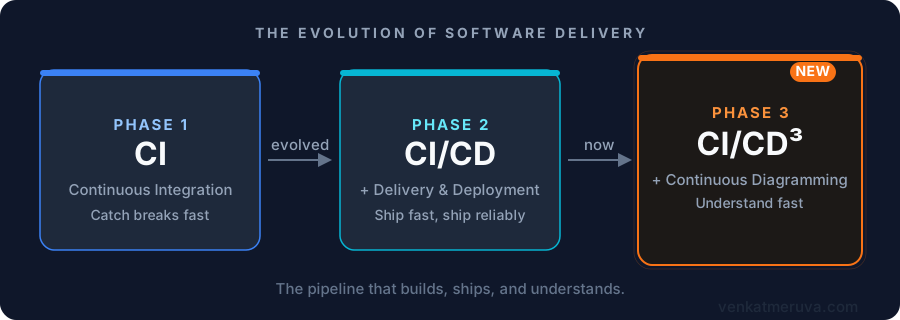
Introducing CI/CD³: The Three Pillars
I want to propose a new term — and I believe its time has come. CI/CD³ (CI/CD Cubed): the three Ds — Delivery, Deployment, and now Diagramming. The first two Ds transformed software engineering. The third transforms organizational intelligence. CI/CD³ is the practice of treating diagrams as living, continuously generated, AI-assisted artifacts that evolve in lockstep with your code, your architecture, and your teams.
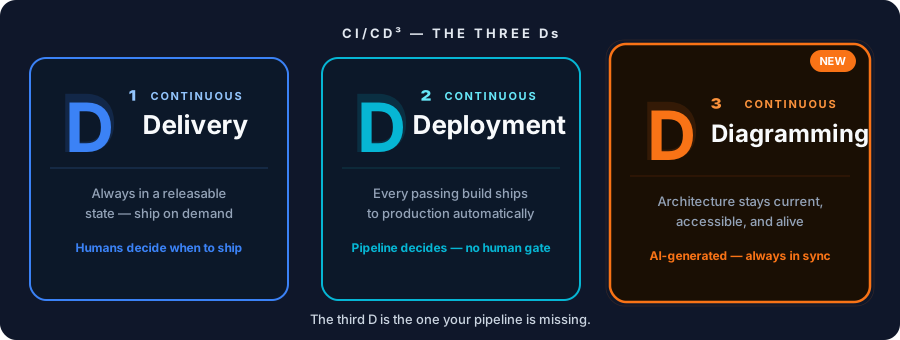
| Pillar | What It Means |
|---|---|
| Continuous Integration | Merge early, merge often, test everything automatically |
| Continuous Delivery (D¹) | Ship to any environment on demand — always in a releasable state |
| Continuous Deployment (D²) | Every passing build ships to production automatically — no human gate |
| Continuous Diagramming (D³) | Architecture, flows, and system understanding stay current, accessible, and alive — AI-generated in lockstep with your code |
The Hidden Cost of Stale Diagrams
Before we talk about the solution, let's be honest about the problem. The cost is real, pervasive, and almost entirely invisible because it's distributed across every role, every team, every sprint.
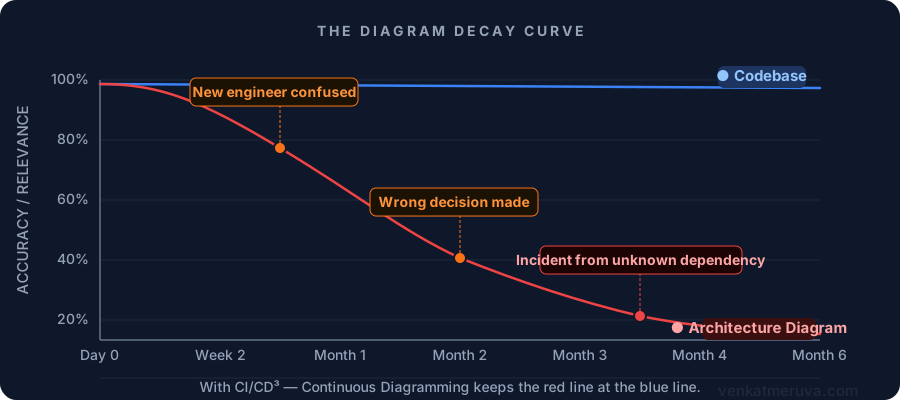
- Onboarding takes months when it should take days. A new engineer finds the architecture diagram showing three microservices. The actual codebase has seventeen. The first month is archaeology, not engineering.
- AI agents hallucinate without context. An agent handed a stale diagram makes stale decisions. An agent given an accurate, current architecture diagram can reason about dependencies, identify risks, and generate code that actually fits the system.
- Cross-functional alignment breaks down silently. The PM thinks the feature touches two systems. The architect knows it touches six. The developer implements it against four. Nobody finds out until production.
- Meetings eat what diagrams should explain. How many hours per week does your org spend in calls where the first 20 minutes are someone sharing their screen explaining how a system works? Every one of those meetings is a failure of diagramming.
What Continuous Diagramming Actually Means
Continuous Diagramming is not 'draw more diagrams.' It is not 'update Confluence more often.' It is a fundamental rethinking of how visual understanding is produced, maintained, and consumed across an organization.
- Diagrams are generated, not drawn — just as CI/CD freed developers from manually deploying code, Continuous Diagramming frees architects from maintaining Visio files. Describe what you're building; the diagram is produced automatically.
- Diagrams are versioned, not filed — a diagram that lives in Git, generated from the same conversation that produced the feature, has history, can be diffed, reviewed, and can trigger a pipeline.
- Diagrams are explained, not just viewed — the same diagram that drives technical decisions can narrate itself in plain English to a non-technical stakeholder, on demand, in real time.
- Diagrams serve every role, not just architects — developers, product managers, QA engineers, executives, and AI agents all consume architecture information differently. Continuous Diagramming delivers to all of them.
The Productivity Multiplier Across Every Role
Here is where CI/CD³ becomes genuinely transformative. The first two pillars of CI/CD were primarily for developers and DevOps engineers. The third pillar serves everyone in the organization.
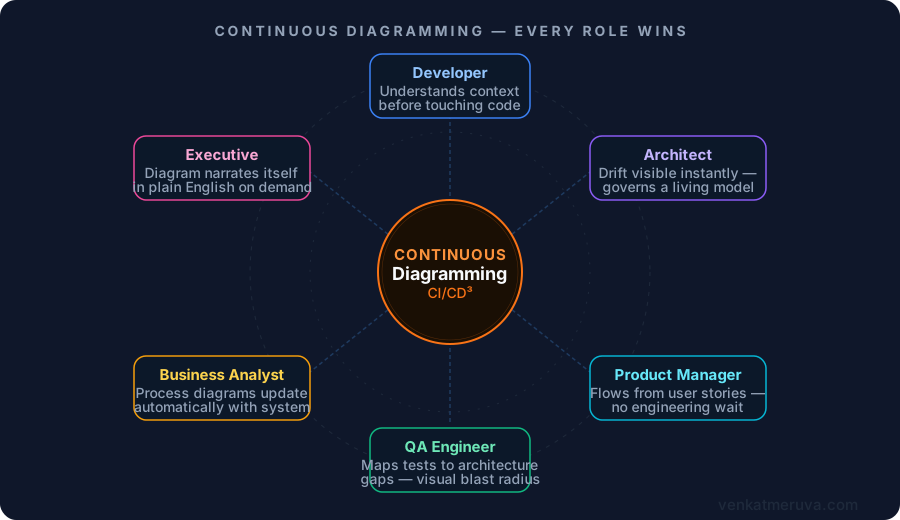
| Role | How Continuous Diagramming Helps |
|---|---|
| Developer | Understands system context before touching code. When done, the diagram updates to reflect what was built. The next developer inherits understanding, not archaeology. |
| Architect | Architectural drift becomes visible. Every change produces an updated diagram. The architect governs a living model, not a static document. |
| Product Manager | Generate a process flow from a user story. Visualize the technical components a feature will touch. Share with stakeholders — without waiting for an engineer's calendar. |
| Business Analyst | Process diagrams auto-updated when the system changes. Documentation that stays current automatically, not on a quarterly update cycle. |
| QA Engineer | Map test cases to architectural components. See the blast radius of a change before it reaches production. Identify untested integration points visually. |
| Executive / Stakeholder | On-demand visual access to the systems they own. A diagram that narrates itself aloud in plain English closes the gap between technical complexity and strategic decisions. |
The Agent Economy Makes This Urgent
We are entering a period of profound change in how software is built. AI agents — autonomous systems that write code, review pull requests, analyze systems, and make architectural decisions — are moving from experiment to production across the technology industry. These agents are only as good as the context they operate in. An agent handed a task without architectural context makes local decisions that may be globally catastrophic. It optimizes the component it can see and breaks the system it cannot. We are already seeing this in early AI-assisted development: impressive outputs at the function level, dangerous surprises at the integration level. Continuous Diagramming is the context layer that the agent economy requires. When every agent, every developer, and every stakeholder operates against a current, accurate, shared visual model of the system — when the architecture is not a document but a live source of truth — the quality of decisions across the entire organization improves dramatically. The companies that build this capability first will not just ship faster. They will think faster.
From Concept to Practice: CI/CD³ Today
The good news: you do not have to wait for CI/CD³ to become an industry standard to start practicing it. The tools exist today.
- Diagramming as code (draw.io XML, Mermaid, PlantUML) — diagrams live in your repository alongside your code, reviewable in pull requests, diff-able across changes.
- AI-assisted diagram generation — describe the system in natural language and the diagram is produced. The time cost of keeping diagrams current approaches zero.
- Voice narration of diagrams — every diagram is also a spoken explanation, accessible to every role and seniority level without requiring a meeting.
- Diagram history — architectural evolution is as traceable as code evolution. See what the system looked like when a decision was made, not just what it looks like now.
The Manifesto Moment
In 2001, seventeen software practitioners gathered at a ski resort in Utah and wrote four lines that changed the industry. They were not proposing new technology. They were proposing a new philosophy — a new relationship between software teams and the work they do. CI/CD³ is a similar proposal. Not a tool. Not a framework. A philosophy. Architecture is a conversation, not a document — it should evolve, breathe, and speak. Understanding is infrastructure — an organization where everyone operates against a current, shared model of the system is an organization that moves at the speed of thought. The pipeline is not complete until the map is current — when you ship a feature, the diagram should ship with it. When a stakeholder needs to understand the system, it should explain itself. We automated the build. We automated the deploy. It is time to automate the understanding.
Takeaway
Add a D to your pipeline. Not just for your developers — for your architects, your product managers, your executives, your AI agents, and everyone else who needs to understand what you are building. The diagram should talk. CI/CD³ is how you make that happen. The question is not whether Continuous Diagramming will become standard practice. The question is whether you will be among the organizations that build this capability now, while it is a competitive advantage, or later, when it is table stakes.